Key Clinical Summary & Takeaways
A blastocyst is an embryo that has developed for 5 to 6 days after fertilisation into a fluid-filled structure containing two specialised cell groups: the inner cell mass (which forms the fetus) and the trophectoderm (which forms the placenta). Extended culture helps embryologists select embryos with stronger developmental potential, though Day 3 transfer remains appropriate when fewer embryos are available.
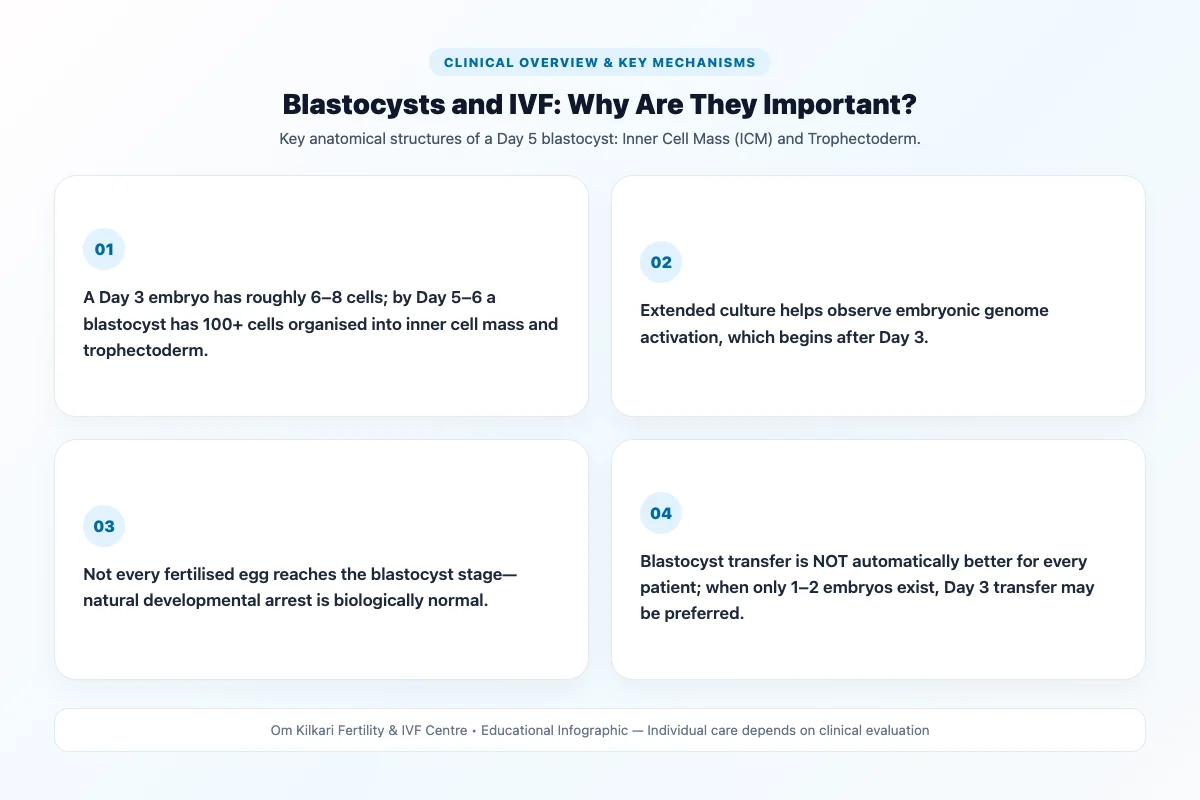
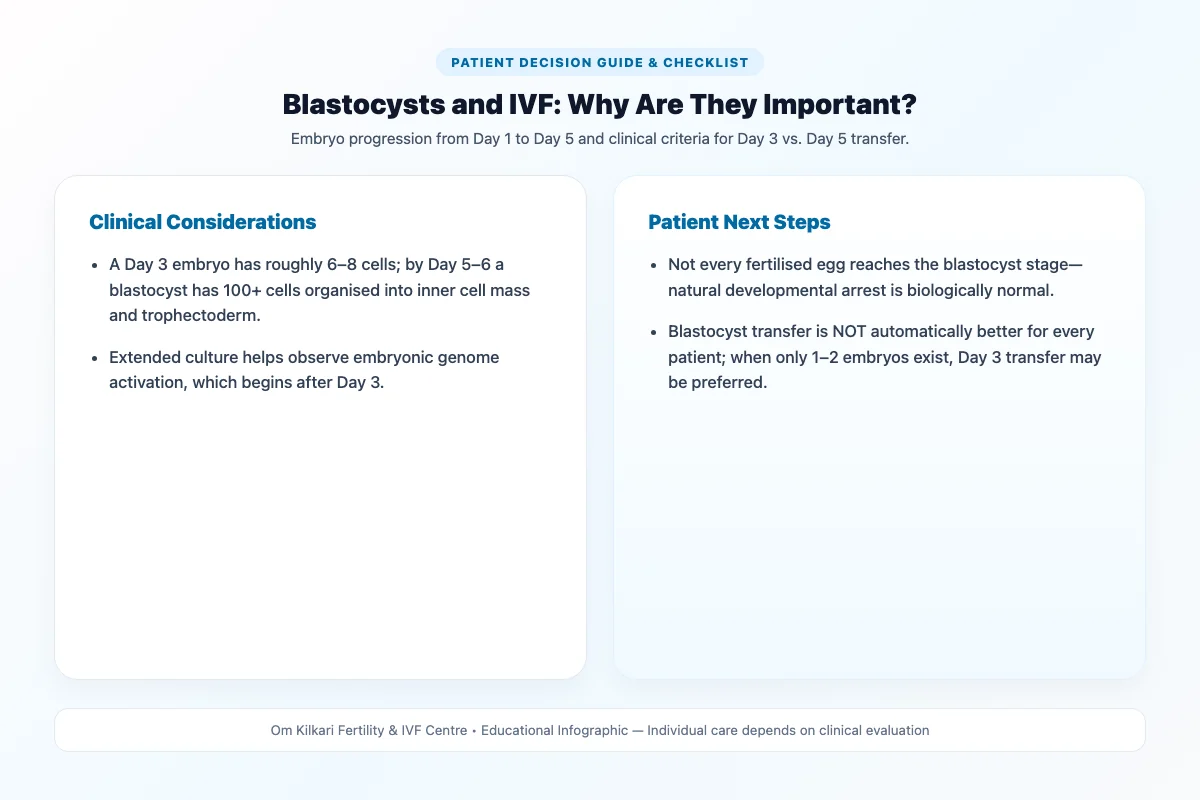
- A Day 3 embryo has roughly 6–8 cells; by Day 5–6 a blastocyst has 100+ cells organised into inner cell mass and trophectoderm.
- Extended culture helps observe embryonic genome activation, which begins after Day 3.
- Not every fertilised egg reaches the blastocyst stage—natural developmental arrest is biologically normal.
- Blastocyst transfer is NOT automatically better for every patient; when only 1–2 embryos exist, Day 3 transfer may be preferred.
What Is a Blastocyst? Inner Cell Mass and Trophectoderm Explained
During natural conception, a fertilised egg divides as it travels down the fallopian tube and reaches the uterus around Day 5 as a blastocyst, just before implantation. Extended embryo culture replicates this timeline in the IVF laboratory.
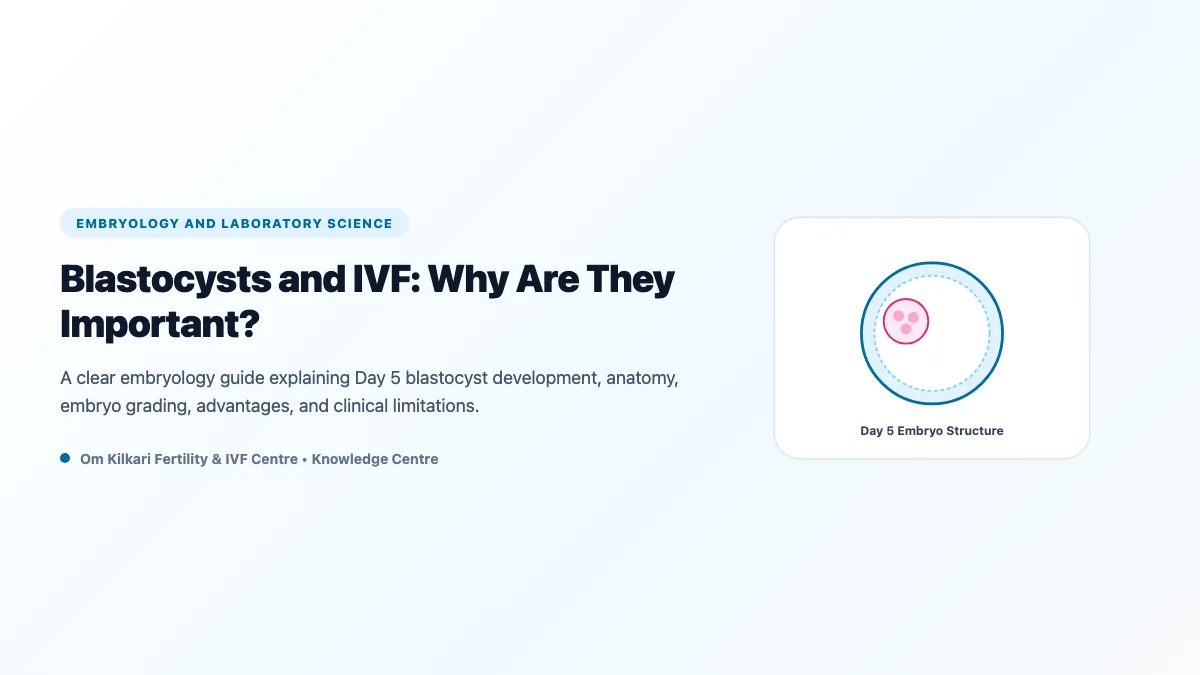
A blastocyst has three clear anatomical parts: a central fluid-filled cavity (blastocoel), an Inner Cell Mass (ICM) that develops into the baby, and an outer layer of cells called the Trophectoderm (TE) that develops into the placenta and membranes.
Day 3 Embryo vs. Day 5 Blastocyst: Key Differences
Up to Day 3 (cleavage stage, typically 6 to 8 cells), early embryo division is largely driven by energy stored in the egg. Around Day 3 to Day 4, the embryo's own combined maternal and paternal genome switches on. Culturing to Day 5–6 lets embryologists see which embryos pass this critical biological checkpoint.
- Day 3 cleavage stage: 6–8 uniform cells; sometimes preferred when total embryo count is very low.
- Day 5–6 blastocyst stage: Differentiated ICM and TE; closely matches natural timing of entry into the uterus.
- Blastocyst culture supports confident single-embryo transfer (SET), helping reduce twin/multiple pregnancy risks.
Understanding Blastocyst Grading
Embryologists commonly grade blastocysts using a three-part score (such as Gardner grading): a number (1 to 6) for cavity expansion, a first letter (A, B, or C) for the Inner Cell Mass, and a second letter (A, B, or C) for the Trophectoderm.
While higher grades (such as 4AA or 4AB) correlate with higher implantation likelihood, lower-graded blastocysts (such as BB or BC) can and do result in healthy babies.
Advantages, Limitations, and Why Some Embryos Arrest
The main advantage of blastocyst culture is better embryo selection and uterine synchrony. However, ASRM and ESHRE evidence highlights an important limitation: roughly 40% to 50% of fertilised embryos naturally stop developing between Day 3 and Day 5, often due to chromosomal abnormalities.
Therefore, for patients with only one or two good-quality Day 3 embryos, transferring on Day 3 avoids the emotional distress of having zero embryos left to transfer on Day 5, without necessarily lowering overall cycle chances.
Your Journey Towards Parenthood Starts with the Right Guidance.
If you have been trying to conceive and would like to understand your fertility health, consult a qualified fertility specialist for personalised guidance.
Frequently Asked Questions
1. Is blastocyst transfer always better than Day 3 transfer?+
No. When multiple good-quality embryos are developing on Day 3, extended culture to Day 5 aids selection. When only one or two embryos are available, a Day 3 transfer may be clinically wiser.
2. Why did only a few of my fertilised eggs become blastocysts?+
Reaching Day 5 requires intact egg and sperm DNA and sustained cellular energy. Natural attrition between Day 3 and Day 5 is biologically normal across all IVF cycles.
3. Can a blastocyst with grade 'B' or 'C' still lead to a healthy baby?+
Yes. Grading is a visual assessment under a microscope—not a genetic diagnosis. Many healthy pregnancies arise from B-grade and selected C-grade blastocysts.
4. Are blastocysts safe to freeze for future transfers?+
Yes. Modern ultra-rapid vitrification freezes blastocysts with very high post-thaw survival rates.
5. Does blastocyst culture help reduce twin pregnancies?+
Yes. Because a single selected blastocyst has strong implantation potential, specialists can often recommend transferring one embryo at a time rather than multiple Day 3 embryos.
Related Articles & Clinic Pages
Written By: Om Kilkari IVF Medical Team • Published: 2026-11-12
Authoritative Clinical References
Disclaimer: This article is for patient awareness and educational purposes only and does not replace personalised medical advice from a qualified fertility specialist.