
Key Clinical Summary & Takeaways
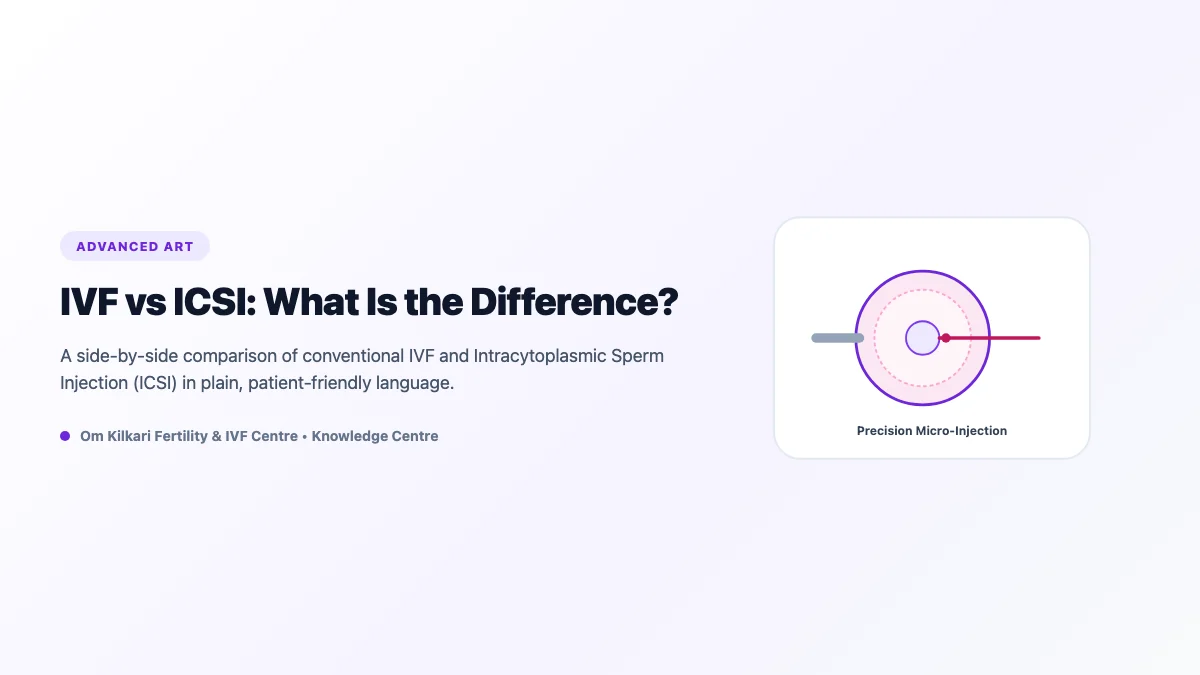
The difference between IVF and ICSI happens solely in the embryology laboratory during fertilisation. In conventional IVF, prepared sperm surround the egg in a culture dish so natural fertilisation occurs; in ICSI, an embryologist gently injects one selected sperm directly into each mature egg—primarily used for male-factor infertility or prior failed fertilisation.
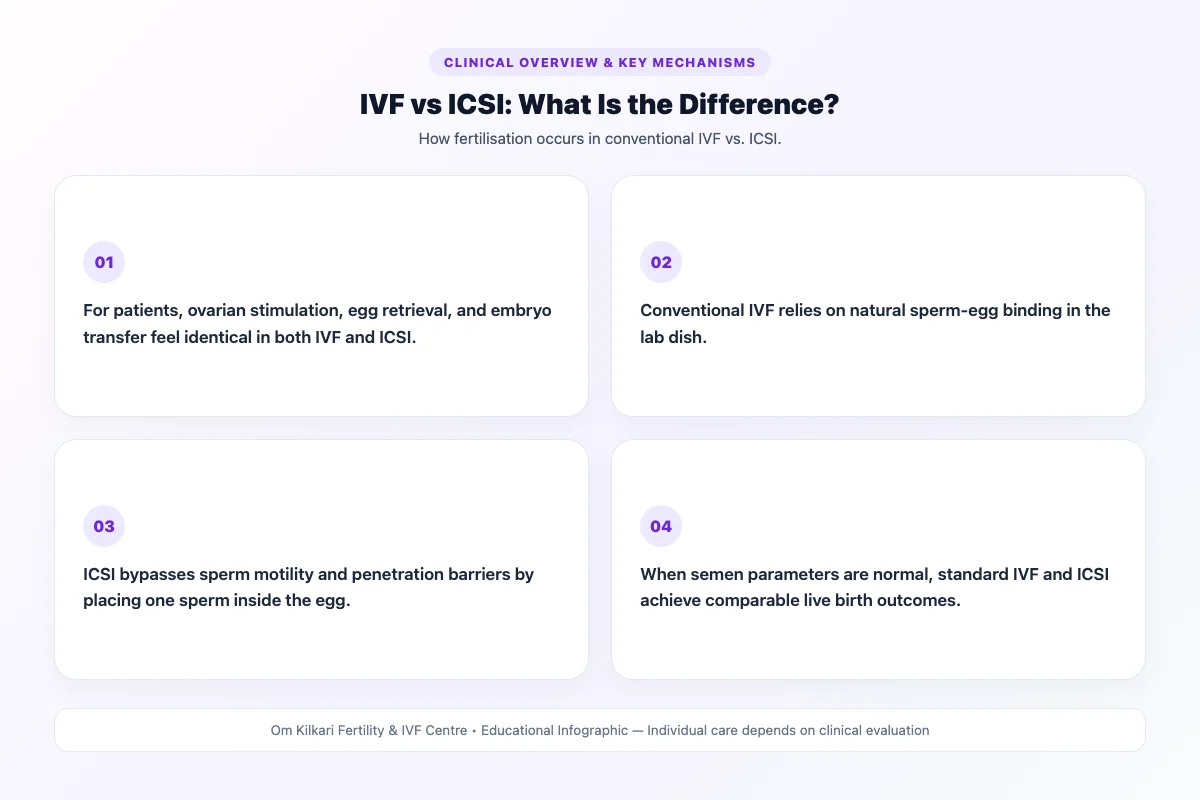
- For patients, ovarian stimulation, egg retrieval, and embryo transfer feel identical in both IVF and ICSI.
- Conventional IVF relies on natural sperm-egg binding in the lab dish.
- ICSI bypasses sperm motility and penetration barriers by placing one sperm inside the egg.
- When semen parameters are normal, standard IVF and ICSI achieve comparable live birth outcomes.
How Laboratory Fertilisation Differs
In conventional IVF, roughly 50,000 to 100,000 motile washed sperm are placed with each retrieved egg in a temperature-controlled dish. One sperm naturally penetrates the egg's outer layer.
In ICSI, the surrounding cumulus cells are gently cleared so egg maturity can be confirmed, and a single motile sperm with normal shape is micro-injected directly into the egg.
When Specialists Recommend One Over the Other
Clinicians review semen count, motility, morphology, and prior cycle history. Conventional IVF is often preferred when sperm parameters are normal, whereas ICSI is essential for severe male factor, surgically retrieved sperm, or frozen oocytes.
Your Journey Towards Parenthood Starts with the Right Guidance.
If you have been trying to conceive and would like to understand your fertility health, consult a qualified fertility specialist for personalised guidance.
Frequently Asked Questions
1. Is the pregnancy process different after ICSI compared to IVF?+
No. Once fertilisation and embryo development occur, embryo transfer and pregnancy care are identical.
2. Why don't clinics use ICSI on every single patient?+
ASRM guidance notes that routine ICSI without male-factor indications adds cost and lab manipulation without improving live birth rates.
3. Can IVF and ICSI be combined in one cycle?+
Yes, in selected borderline cases, eggs may be split between standard IVF and ICSI.
Related Articles & Clinic Pages
Written By: Om Kilkari IVF Medical Team • Published: 2026-11-12
Authoritative Clinical References
Disclaimer: This article is for patient awareness and educational purposes only and does not replace personalised medical advice from a qualified fertility specialist.