
Key Clinical Summary & Takeaways
ICSI (Intracytoplasmic Sperm Injection) is primarily recommended when sperm struggle to fertilise an egg naturally—such as severe low sperm count, poor motility, abnormal morphology, surgically retrieved sperm, prior IVF fertilisation failure, or use of frozen oocytes. ASRM guidance notes that for couples without male-factor infertility, ICSI does not automatically outperform conventional IVF.
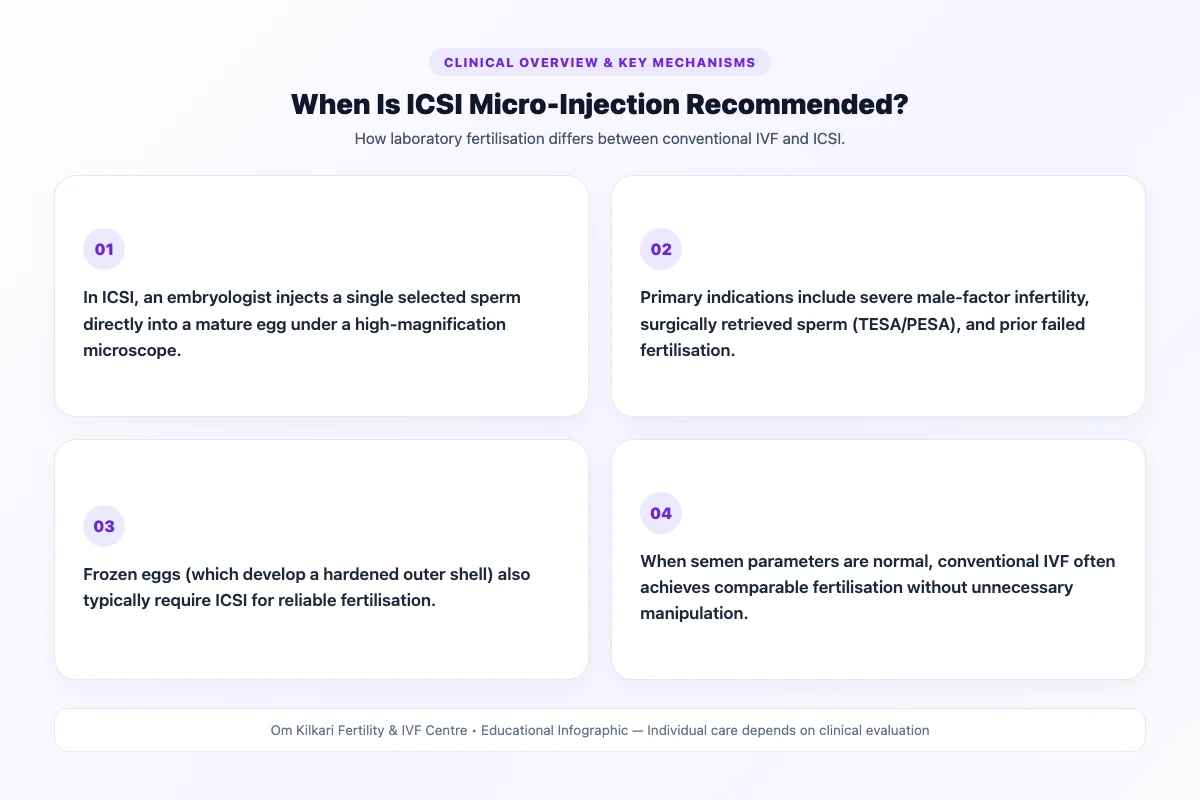
- In ICSI, an embryologist injects a single selected sperm directly into a mature egg under a high-magnification microscope.
- Primary indications include severe male-factor infertility, surgically retrieved sperm (TESA/PESA), and prior failed fertilisation.
- Frozen eggs (which develop a hardened outer shell) also typically require ICSI for reliable fertilisation.
- When semen parameters are normal, conventional IVF often achieves comparable fertilisation without unnecessary manipulation.
What Happens During ICSI Micro-Injection?
During standard IVF, thousands of prepared motile sperm are placed near each retrieved egg in a culture dish so fertilisation occurs naturally. In ICSI, the embryologist uses specialised micromanipulation tools under an inverted microscope to pick up one morphologically selected motile sperm in a microscopic glass needle and place it directly inside the egg's cytoplasm.
The ovarian stimulation, egg retrieval, embryo culture, and embryo transfer steps remain identical to conventional IVF—only the fertilisation step in the laboratory differs.
Primary Medical Situations Where ICSI Is Recommended
Evidence-based guidelines from ASRM and ESHRE outline clear clinical scenarios where ICSI provides a genuine advantage over standard IVF:
- Severe oligozoospermia (very low sperm concentration) or asthenozoospermia (severely reduced forward motility).
- Severe teratozoospermia (high percentage of abnormally shaped sperm) impairing egg penetration.
- Surgically retrieved sperm from the testes or epididymis (such as TESA, TESE, or PESA) in obstructive or non-obstructive azoospermia.
- Total failed fertilisation or very low fertilisation in a previous conventional IVF cycle.
- Fertilisation of cryopreserved (frozen) oocytes, as freezing can harden the egg's zona pellucida.
- Selected cycles involving preimplantation genetic testing (PGT) to reduce extraneous sperm DNA contamination.
Is ICSI Always Better Than Conventional IVF?
Many couples assume that because ICSI is more advanced, it automatically gives higher pregnancy rates for everyone. However, ASRM Practice Committee guidance clarifies that in non-male-factor infertility (such as tubal blockage or unexplained infertility with normal semen parameters), routine ICSI does not improve live birth outcomes compared with standard IVF.
Choosing between IVF and ICSI should always be an individualised clinical and embryological decision based on semen analysis on the day of egg retrieval and your medical history.
How Male Fertility Is Evaluated Before Recommending ICSI
Before deciding on ICSI, specialists usually review two semen analyses (if an initial report shows abnormalities), hormone profiles such as FSH, LH, and testosterone when indicated, and physical examination to rule out treatable conditions like varicocele or genital tract obstruction.
Your Journey Towards Parenthood Starts with the Right Guidance.
If you have been trying to conceive and would like to understand your fertility health, consult a qualified fertility specialist for personalised guidance.
Frequently Asked Questions
1. Does ICSI hurt the egg or change the baby's health?+
Experienced embryologists perform ICSI gently on mature eggs; a small fraction of fragile eggs may not survive injection. Overall, most children conceived via ICSI are healthy, though specialists counsel couples on small baseline risks associated with underlying severe male infertility.
2. Can ICSI work if zero sperm are seen in the semen sample?+
In obstructive azoospermia and selected non-obstructive cases, sperm can sometimes be retrieved directly from the epididymis or testis and used with ICSI. A urology/andrology evaluation confirms whether retrieval is feasible.
3. Is ICSI guaranteed to fertilise 100% of retrieved eggs?+
No. While ICSI significantly improves fertilisation rates in male-factor cases, fertilisation still depends on egg maturity, egg quality, and sperm activation.
4. Can a clinic do half IVF and half ICSI (split IVF-ICSI)?+
Yes, in borderline semen parameters or unexplained infertility with adequate egg numbers, specialists sometimes recommend fertilising half the eggs via standard IVF and half via ICSI.
5. How should the male partner prepare before an ICSI cycle?+
Maintain 2 to 5 days of abstinence before sample collection, avoid fever or smoking in the preceding weeks, and inform the clinic about all current medications.
Related Articles & Clinic Pages
Written By: Om Kilkari IVF Medical Team • Published: 2026-11-12
Authoritative Clinical References
Disclaimer: This article is for patient awareness and educational purposes only and does not replace personalised medical advice from a qualified fertility specialist.