Key Clinical Summary & Takeaways
In India, working with an egg donor involves two coordinated clinical pathways—medical screening and stimulation of an ART-bank-registered oocyte donor alongside endometrial preparation and embryo transfer for the intended mother. Total costs depend on ART bank registration/screening fees, stimulation medications, ICSI laboratory work, embryo freezing, and recipient monitoring, and must strictly follow India's Assisted Reproductive Technology (Regulation) Act, 2021.
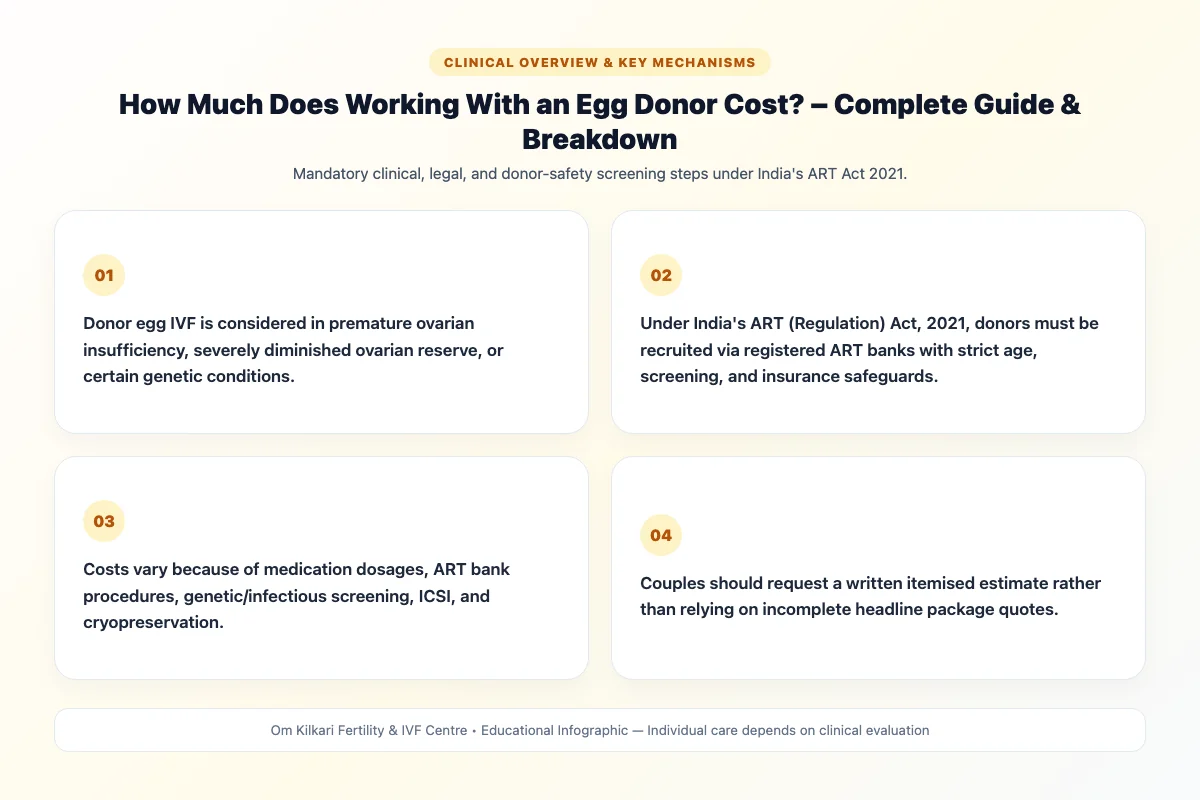
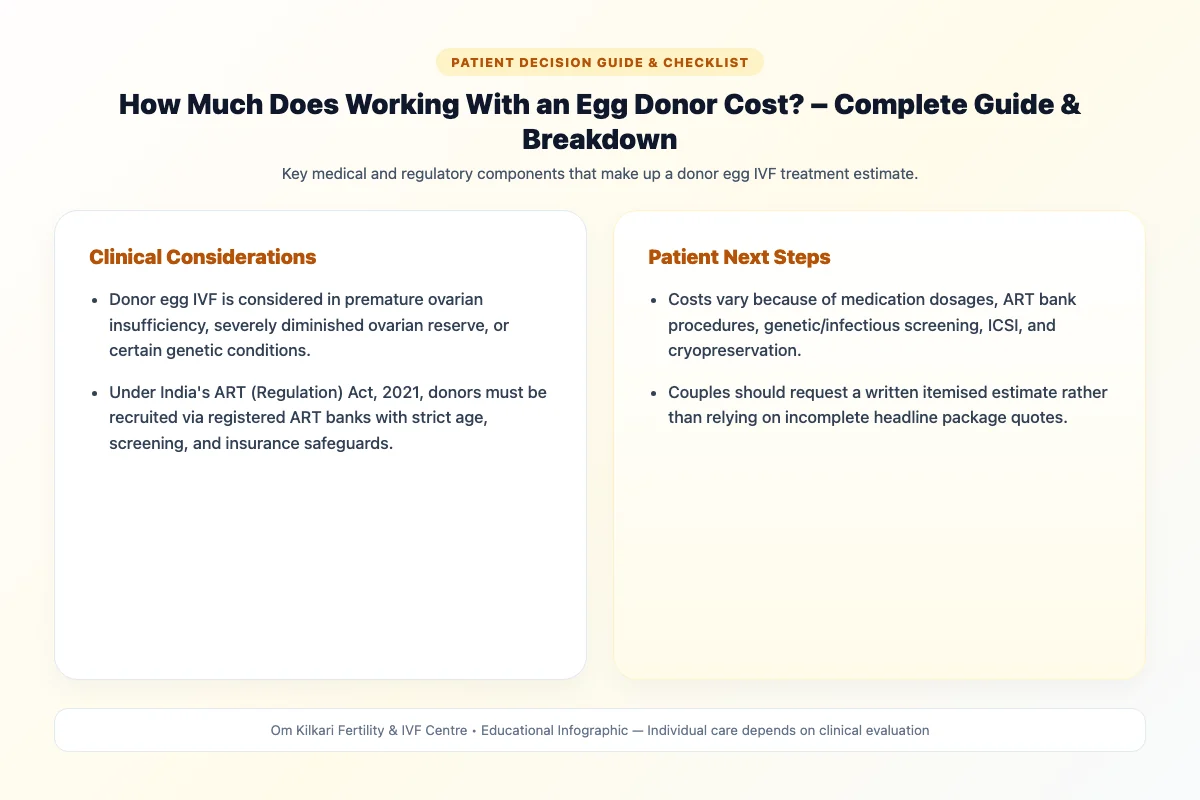
- Donor egg IVF is considered in premature ovarian insufficiency, severely diminished ovarian reserve, or certain genetic conditions.
- Under India's ART (Regulation) Act, 2021, donors must be recruited via registered ART banks with strict age, screening, and insurance safeguards.
- Costs vary because of medication dosages, ART bank procedures, genetic/infectious screening, ICSI, and cryopreservation.
- Couples should request a written itemised estimate rather than relying on incomplete headline package quotes.
What Egg Donation Involves and When It Is Considered
Donor egg IVF allows a woman to carry a pregnancy using eggs donated by a medically screened donor, fertilised in the laboratory with her partner's sperm (or donor sperm when clinically indicated), and transferred into her own prepared uterus.
Specialists may discuss donor oocytes in situations such as premature ovarian insufficiency (early menopause), severely reduced ovarian reserve not responding to stimulation, repeated IVF failures linked to poor egg quality, or specific inherited genetic conditions.
Donor Eligibility, Medical Screening, and ART Act 2021 Rules
In India, oocyte donation is strictly governed by the Assisted Reproductive Technology (Regulation) Act, 2021 and its accompanying Rules. Commercial trading or unregistered matching is prohibited, and all donors must be registered through licensed ART banks.
- Legal age limits (typically 23 to 35 years for female oocyte donors) and marital/parenthood eligibility criteria as defined under the ART Rules.
- Comprehensive infectious disease screening (HIV, Hepatitis B, Hepatitis C, syphilis) and blood group evaluation.
- Genetic, medical, and psychological screening to confirm fitness to donate safely.
- Mandatory health insurance coverage for the oocyte donor against stimulation/retrieval complications, plus one-time donation limits under the Act.
Basic Stages of the Donor Egg IVF Process
A donor IVF cycle synchronises or separates the donor's ovarian stimulation from the recipient's uterine preparation:
- 1. Counselling and legal consent: Both partners complete clinical counselling, legal documentation, and Aadhaar-verified ART registry formalities.
- 2. Donor stimulation and monitoring: The registered donor receives tailored hormonal medications and ultrasound tracking.
- 3. Egg retrieval and fertilisation: Mature eggs are retrieved and fertilised in the lab with the partner's sperm (often via ICSI).
- 4. Recipient endometrial preparation and transfer: The recipient's uterine lining is prepared with oestrogen and progesterone before fresh or frozen embryo transfer.
Medical and Treatment Cost Components Explained
Because every clinic operates within different hospital infrastructures and individual patients need different clinical steps, there is no single fixed price nationwide. Asking for an itemised breakdown helps couples compare estimates transparently:
- ART Bank coordination, donor medical screening, and mandatory donor complication insurance.
- Ovarian stimulation injections and monitoring scans for the donor cycle.
- Egg retrieval procedure, anaesthesia, and embryology laboratory charges (IVF/ICSI and blastocyst culture).
- Recipient endometrial preparation scans, blood tests, and embryo transfer.
- Optional embryo freezing (vitrification) and annual storage fees for surplus embryos.
Important Questions Couples Should Ask Before Proceeding
Before signing consent forms, verify that both the fertility clinic and the partner ART bank hold valid registration under the ART Act 2021, confirm what is included versus excluded in the written quote, and discuss emotional counselling support for your family.
Your Journey Towards Parenthood Starts with the Right Guidance.
If you have been trying to conceive and would like to understand your fertility health, consult a qualified fertility specialist for personalised guidance.
Frequently Asked Questions
1. Why can't clinics publish a single fixed fee for donor egg IVF?+
Total expenses depend on individual stimulation medication needs, ART bank screening and insurance requirements, whether ICSI or frozen embryo transfer is used, and whether surplus embryos are cryopreserved.
2. Is egg donation legal and regulated in India?+
Yes. Egg donation is legally regulated under India's Assisted Reproductive Technology (Regulation) Act, 2021, which mandates registered ART clinics/banks, informed consent, donor health insurance, and confidentiality.
3. Can a woman still carry and bond with a baby conceived through donor eggs?+
Yes. The intended mother carries the pregnancy from implantation through birth, provides the uterine environment and nutrition, and is recognised as the legal mother.
4. How long does a donor egg IVF cycle take?+
Screening, legal documentation, donor cycle synchronisation or frozen transfer preparation typically span 4 to 8 weeks, depending on whether fresh or frozen transfer is planned.
5. Should we seek psychological counselling before choosing donor eggs?+
Yes. Speaking with a fertility counsellor helps couples process grief over genetic linkage, align expectations, and feel confident about their decision.
Related Articles & Clinic Pages
Written By: Om Kilkari IVF Medical Team • Published: 2026-11-12
Authoritative Clinical References
Disclaimer: This article is for patient awareness and educational purposes only and does not replace personalised medical advice from a qualified fertility specialist.